Know Before You Go
Black Bear vs Grizzly: How to Tell
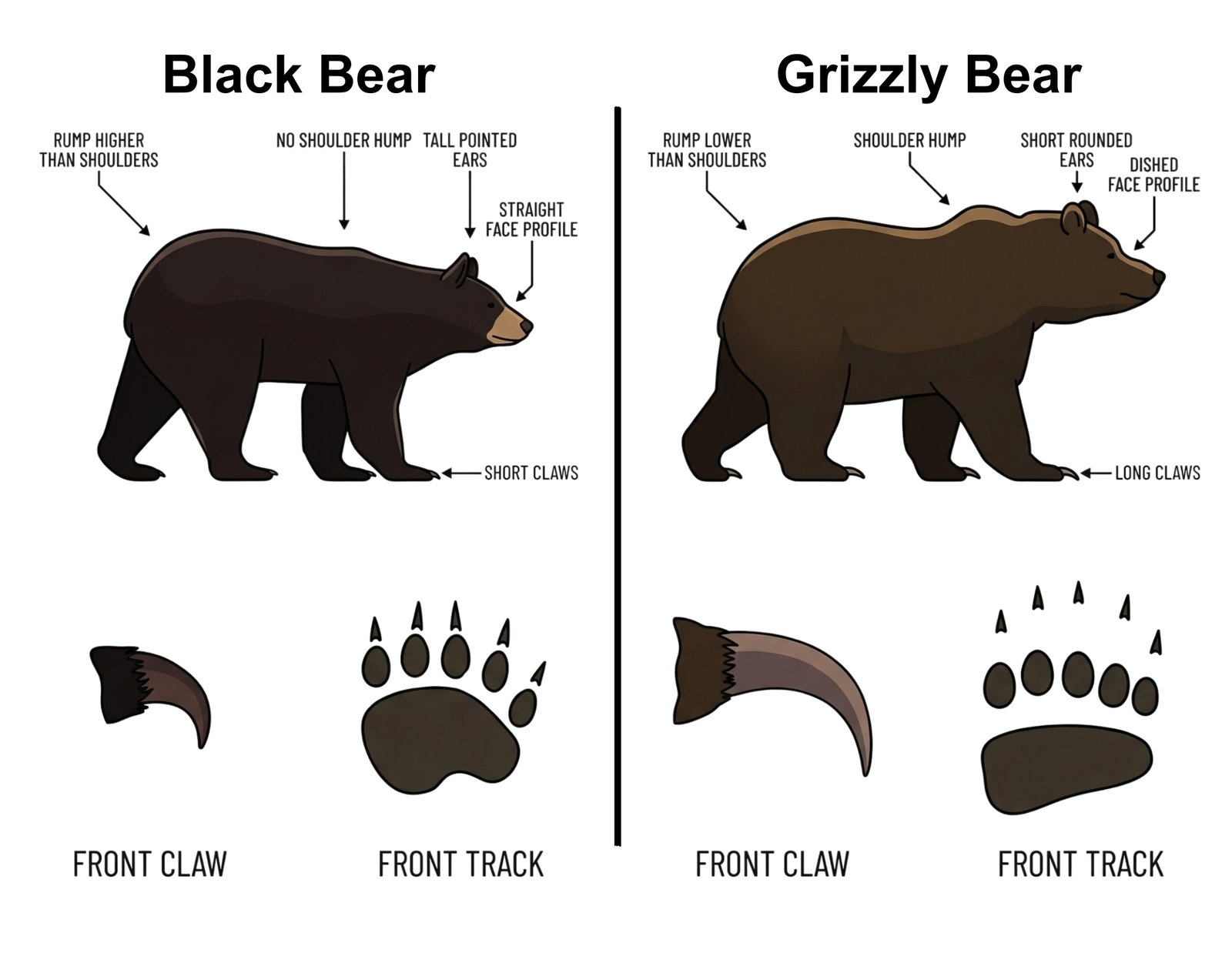
Identifying the species matters because the correct response to an encounter is different. Here are the key visual differences, even at a distance.
Protecting endangered species. Grizzly bears are a threatened species in Alberta (fewer than 700 remaining). Grizzly and cougar locations on TrailBear are offset to prevent poaching, by 500m in Canada and up to 1km in the US. All other species are shown exactly. True coordinates for grizzlies and cougars never leave our database.
Colour Is Not Reliable
Despite the names, coat colour is one of the least reliable ways to tell species apart. In Yosemite, 91% of black bears are brown or blond. In Minnesota, 94% are actually black. Grizzly bears can also appear black. In areas where both species live, a black-coloured bear could be either species.
Key Differences
Shoulder Hump
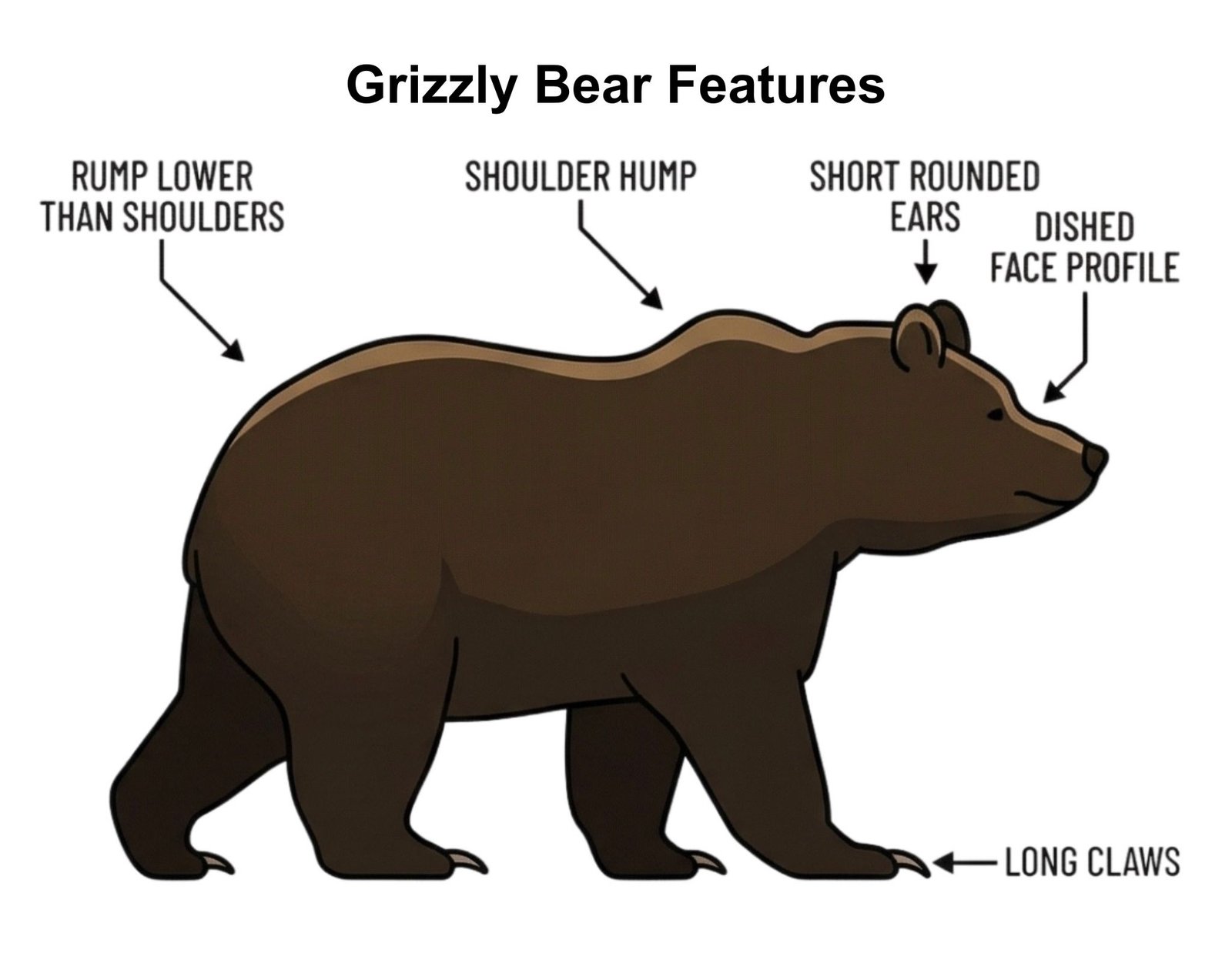
Grizzly
Prominent muscular hump between the shoulders. Visible in profile.
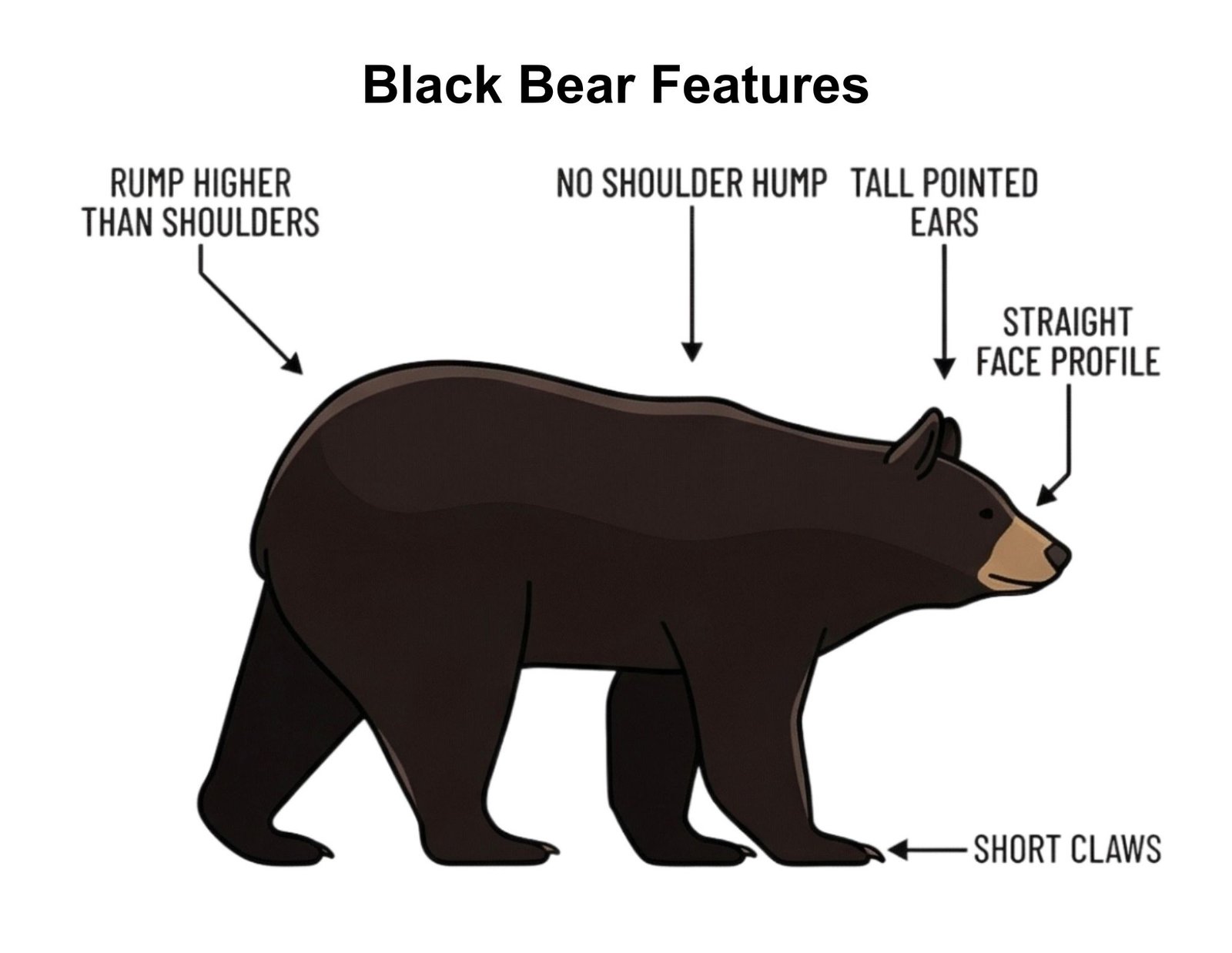
Black Bear
No shoulder hump. The highest point is the rump. Black bears can appear to have one when their head is lowered.
Face Profile
Grizzly
Concave, dish-shaped face when viewed from the side. The forehead dips down to the nose.
Black Bear
Straight or convex face profile ("Roman nose"). The line from forehead to nose is relatively straight.
Ears
Grizzly
Short, rounded ears that appear small relative to the head.
Black Bear
Taller, more pointed ears that are more prominent.
Front Claws
Grizzly
1.5 to 3.9 inches long. Lighter in colour. Straighter. Leave claw marks far from the toe prints in tracks.
Black Bear
1.1 to 2.0 inches long. Dark coloured. More curved. Claw marks appear closer to toe prints.
Chest Markings
Grizzly
May have an indefinite white collar extending from chest to shoulders. Never a distinct chest patch.
Black Bear
Often has a distinct white or cream V-shaped chest blaze. This is a strong indicator of black bear.
Guard Hairs
Grizzly
White-tipped guard hairs on the back and shoulders create a "grizzled" or frosted appearance. This is where the name comes from.
Black Bear
Guard hairs are not white-tipped. Coat appears uniform in colour.
Size
Grizzly
Adult males average 300 to 850+ lbs depending on region. Coastal bears are the largest. Females roughly half male weight.
Black Bear
Adult males typically 200 to 400 lbs. Generally smaller than grizzlies, but large male black bears can overlap with female grizzly size.
Identifying Tracks
Wildlife researcher Stephen Herrero identifies four characteristics for distinguishing tracks. The most reliable are toe arc and toe joining, not overall size.
Toe Arc (Most Reliable)
Place a straightedge along the base of the big toe and the top of the pad. If the line passes below the middle of the small toe, it is a grizzly. If above, it is a black bear. Black bear toes arc more; grizzly toes sit in a straighter line.
Toe Joining (Most Reliable)
On reasonably firm ground, grizzly toes appear joined together at the base. Black bear toes appear as separate, distinct impressions.
Claw-to-Toe Distance
Grizzly tracks show a longer gap between the toe pad and the claw mark because their claws are longer and straighter.
Overall Size
Very large tracks are usually grizzly, but this is unreliable alone. A large male black bear track can equal a small female grizzly track, and soft ground makes tracks appear larger.
Common Myths
"Bears can't run downhill." Completely false. Bear behaviour researcher Stephen Herrero has watched grizzlies chase elk and sheep downhill, uphill, and sidehill without stumbling. Bears can sprint at up to 55 km/h on any terrain.
"Bears have poor eyesight." Not true. Experiments show black bears learn colour discrimination tasks faster than chimpanzees. Bears may simply rely more on their sense of smell, which allows them to detect carcasses from several miles away.
This guide is informed by Stephen Herrero's Bear Attacks: Their Causes and Avoidance (3rd Edition, 2018) and Parks Canada species identification guidelines.